As an Amazon Associate this site earns from qualifying purchases.
Side-by-side specs (DHP models)
| Model | Configuration | Frame | Assembled dimensions | Weight limit (top / bottom) | Max top mattress | Price |
|---|---|---|---|---|---|---|
| DHP Dylan Convertible Wood | Twin over twin | Wood | 44"W x 79"L x 63"H | 165 lb per level | Not stated (coil spring twin) | Check price on Amazon |
| DHP Miles Low Metal | Twin over twin | Metal | 77.5"L x 41.5"W x 54"H | 200 / 250 lb | 6" | Check price on Amazon |
| DHP Dusty Metal | Twin over full | Steel | 78"L x 56.5"W x 61.5"H | 200 / 350 lb | 6" | Check price on Amazon |
| DHP Miles Metal Full/Full | Full over full | Metal | 77.5"L x 56.5"W x 54"H | 300 / 450 lb | 6" | Check price on Amazon |
| DHP Twin-Over-Futon | Twin over futon/full | Metal | 78"L x 44"W x 72.5"H (sitting) | 200 lb top / 600 lb futon | 6" | Check price on Amazon |
| DHP Full Over Full Metal | Full over full | Metal | 78.5"W x 56.5"D x 72"H | Not stated | 6" | Check price on Amazon |
Quick answer: If you're cross-shopping Delta Children against DHP, the practical split is that Delta Children is generally shopped as a kids-furniture brand with a nursery-to-toddler feel, while DHP's bunk line leans metal, low-profile and space-driven — and it's the DHP models below that have published spec sheets we can compare line by line. Pick a DHP metal frame if your priority is a low ceiling clearance, a high posted weight limit, or a small room; pick the wood Dylan if you want something that separates into two standalone twin beds later. Whatever Delta Children model you're eyeing, hold it to the same three numbers used throughout this guide: posted weight limit per bunk, maximum top-bunk mattress thickness, and total assembled height.
A note on fairness: this comparison only makes specific factual claims about the DHP beds listed here, because those are the listings with full published specs in front of us. For any Delta Children bunk you're considering, pull its own listing and compare the same fields — and read its recent owner reviews yourself rather than trusting a summary.
DHP Dylan Convertible Wood Bunk Bed, Stackable and Detachable Bed Frames for Kids and Teens, with Ladder, High Guardrail, Wood Slats, No Boxspring Required, Twin-Over-Twin, White — the one that becomes two beds
The DHP Dylan Convertible Wood Bunk Bed, Stackable and Detachable Bed Frames for Kids and Teens, with Ladder, High Guardrail, Wood Slats, No Boxspring Required, Twin-Over-Twin, White is the outlier in this group: it's wood rather than metal, and it separates into two standalone twin beds. That matters more than it sounds. Bunk beds have a shelf life in a kid's life, and a frame that converts into two normal beds when the sharing phase ends is a frame you buy once.
Finding the right delta children vs dhp bunk beds comes down to matching the features to how you will actually use it.
Specs to weigh: 44"W x 79"L x 63"H assembled, 165 lb per level, and a 4-step ladder with guard rails on the top bunk. The listing specifies it's designed for two standard twin-size coil spring mattresses only, with no box spring. At $314.99 it's the priciest twin-over-twin here, and the 165 lb per level limit is the lowest posted number in this lineup — worth noting if a parent plans to lie down up top at bedtime.
DHP Miles Low Metal Bunk Bed Frame for Kids, With Built-in Ladder, High Guardrail and Metal Slats, Floor Bed Bottom Bunk, No Boxspring Required, For Small Spaces, Twin-Over-Twin, Silver — the low-ceiling pick
At 54" tall, the DHP Miles Low Metal Bunk Bed Frame for Kids, With Built-in Ladder, High Guardrail and Metal Slats, Floor Bed Bottom Bunk, No Boxspring Required, For Small Spaces, Twin-Over-Twin, Silver is the shortest twin-over-twin in the group, which is the whole point. The bottom bunk sits on the floor, leaving 37" of clearance between beds — enough for a younger child to sit up, and low enough that the top bunk doesn't feel like a loft.
Other numbers: 77.5"L x 41.5"W x 54"H, 200 lb top / 250 lb bottom, metal slats spaced 3.5" apart, 12.5" full-length guardrails, and a 6" maximum mattress height. The ladder is integrated into the frame and can only go on one side, so measure your room and decide which wall it faces before assembly, not after. It's also the cheapest bed here at $198.98.
DHP Dusty Metal Bunk Bed with Secured Ladders, Twin/Full, Black — for a big kid and a little kid
Mismatched siblings are exactly what the DHP Dusty Metal Bunk Bed with Secured Ladders, Twin/Full, Black is shaped for: a twin on top, a full underneath, so the older or larger child gets the bigger mattress. Posted limits are 200 lb upper and 350 lb bottom, with 13" guard rails around the top bunk and slats spaced 2.5" apart.
Two features stand out. It has two integrated ladders, so access works from either side — useful when the bed has to sit in a corner. And it leaves 11" of underbed clearance, which is enough for flat storage bins. Assembled it's 78"L x 56.5"W x 61.5"H, ships in one box with tools and instructions, and carries a 1-year limited warranty. At $183.97 it's the lowest price in this comparison despite being the larger configuration.
DHP Miles Metal Bunk Bed, White, Full/Full — the highest posted weight limits
If the ceiling is low but both sleepers need a full mattress, the DHP Miles Metal Bunk Bed, White, Full/Full is the specific answer: 54" tall assembled, 77.5"L x 56.5"W, with a floor-level bottom bunk and a 3-step integrated ladder. Its posted limits — 300 lb top, 450 lb bottom — are the highest stated numbers here, which makes it the most credible option for teens or for an adult sharing a guest room.
It takes two full-size 6" mattresses, uses heavy-duty metal slats with raised sides to stop mattress slide, and has a powder-coated finish. $319.99, 1-year limited warranty.
DHP Twin-Over-Futon Convertible Couch and Bed with Metal Frame, Ladder and Guardrails - Black — dorm and guest-room duty
The DHP Twin-Over-Futon Convertible Couch and Bed with Metal Frame, Ladder and Guardrails - Black solves a different problem: the room needs to be a sitting room by day. The bottom is a futon that converts to a full-size sleeper, with a childproof mechanism on the conversion. Footprint changes with mode — 78"L x 44"W x 72.5"H sitting, 78"L x 54.5"W sleeping — so leave clearance in front.
Weight limits are 200 lb on the top bunk and 600 lb on the futon. It has two 12"-wide integrated side ladders, 13" upper guard rails, and 2.5"-spaced slats. Top mattress maxes at 6". Both the twin mattress and the full futon mattress are sold separately, which is the hidden cost on a $351.81 frame.
DHP Full Over Full Metal Bunk Bed, Black, Space-Saving Kids Furniture, Sturdy Frame, Guard Rails, Integrated Ladder — full-over-full at a lower price
The DHP Full Over Full Metal Bunk Bed, Black, Space-Saving Kids Furniture, Sturdy Frame, Guard Rails, Integrated Ladder is the conventional-height take on full-over-full: 78.5"W x 56.5"D x 72"H, square-post metal frame, guard rails and an integrated ladder, 108 lb. It takes two 75" x 54" full mattresses with a 6" maximum thickness up top, and it's $292.99.
The honest caveat: this listing doesn't publish per-bunk weight limits. If that number matters to you — and for a full-over-full it should — either confirm it with DHP before ordering or choose a model that states it, like the Miles Full/Full.
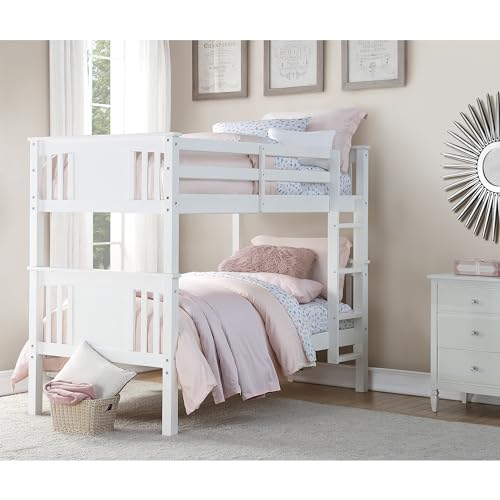
- Traditional twin size bunk bed for kids. Conveniently separates into two separate twin beds
- Sturdy construction with a 4-step ladder and guard rails for added security on top bunk. Headboard and footboard feature a combination of a full panel and slat design
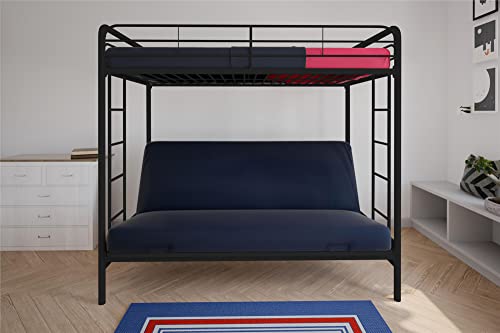
- Multi-functional metal bunk bed over convertible futon couch design. Bottom bunk can be used as a sofa or a full size bed. Perfect for kids bedrooms, dorm rooms, teens rooms or
- Twin size mattress and full size futon mattress are sold separately. Maximum recommended upper mattress thickness of 6 inches. Available in white, black or silver metal
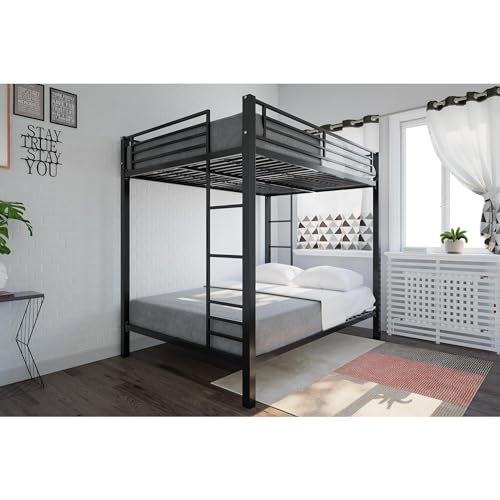
- Sturdy, metal frame with square posts for durability and style
- Space-saving design with maximum upper mattress thickness of 6 inches
The trade-offs nobody puts in the listing
The 6" mattress ceiling is real. Five of these six frames cap the top mattress at 6". Most mattresses sold today are thicker than that. Go over the limit and the guardrail stops being a guardrail, because the effective rail height drops by every inch of extra mattress. Budget for a genuinely thin top mattress and treat it as part of the price.
Metal is cheaper, wood converts. The metal frames here undercut the wood Dylan and post higher weight limits, but the Dylan is the only one that splits into two usable beds. That's a five-year decision versus a today decision.
Low-profile means low clearance. The 54"-tall Miles models are great under a sloped ceiling; the 37" between-bunk clearance on the twin-over-twin is fine for a child and tight for an adult tucking one in.
Assembly is on you. Every one of these ships flat with tools and instructions. Plan a couple of hours and a second pair of hands, and re-torque the bolts a month later — that's the single maintenance step that keeps a bunk from developing a wobble.
Delta Children comparison, done properly. Because we can't verify Delta Children specs here, don't take anyone's word for them. Open the listing, find weight limit, top-bunk mattress maximum, assembled height and warranty term, and drop them into the table above. If a Delta Children model doesn't publish a weight limit, treat that the same way you'd treat the missing number on the DHP Full Over Full — as a question to answer before you buy.
FAQ
Which is safer, a metal or a wood bunk bed? Material isn't the safety variable — guardrail height, mattress thickness and assembly quality are. Among these, the Dusty and the Twin-Over-Futon post 13" guard rails and the Miles models post 12.5". Compare that number against your intended mattress thickness on any brand, Delta Children included.
Can adults sleep in these? Look at the posted limits, not the vibe. The DHP Miles Metal Bunk Bed, White, Full/Full states 300 lb top and 450 lb bottom, and the Twin-Over-Futon states 600 lb on the futon — those are the adult-plausible numbers here. The wood Dylan's 165 lb per level is the tightest.
Do I need a box spring? No. Every DHP model listed here states that a box spring isn't required; the slats do the supporting. Adding one would also eat into your top-bunk clearance.
What should I check in owner reviews before buying? Go read them yourself, and search within them for three things specifically: hardware quality complaints, whether the ladder placement caused a room-layout problem, and how the frame held up after a year. Those are the issues spec sheets can't tell you about.
Related guides
- Zinus Shalini Upholstered Platform Bed Frame Review
- Best beds and bedroom furniture - bed frames, platform beds, headboards, bunk beds, kids beds, daybeds, nightstands, dressers, chest of drawers, wardrobes After Recent Issues
- Common Reasons Best beds and bedroom furniture - bed frames, platform beds, headboards, bunk beds, kids beds, daybeds, nightstands, dressers, chest of drawers, wardrobes Gets Denied
Key Takeaways
- Choosing the right delta children vs dhp bunk beds means matching the key features to your specific needs and budget
- Read real customer reviews and check the return policy before you commit
- Compare value across models — the priciest option is not always the best fit