As an Amazon Associate this site earns from qualifying purchases.
Comparison table
| Product | Price | Weight capacity | Trundle | Storage | Charging |
|---|---|---|---|---|---|
| LIKIMIO Premium Twin Corner Daybed, Beige | Check price on Amazon | 880 lbs | No | 2 drawers, 29.5" x 19.3" x 6" | Not stated |
| IDEALHOUSE Twin Daybed with Trundle | Check price on Amazon | 350 lbs | Yes, 6 casters | 12" under-bed clearance | Not stated |
| MSmask Daybed with High Bookcase | See the product list on this page | 800 lbs | No | 6 drawers, 3 shelves, 12.2" clearance | 2 AC + 2 USB |
| LIKIMIO Twin Daybed with Pop Up Trundle | Check price on Amazon | 900 lbs | Yes, pop-up to king | Headboard storage + pockets | Charging station |
| COMASACH 14 Inch Classic Twin Daybed | Check price on Amazon | Not stated | No | Under-bed clearance (14" frame) | Not stated |
| Yumenonaka Twin Daybed | Check price on Amazon | 600 lbs | No | 12" under-bed storage | Not stated |
Quick answer: If you want one piece that seats people by day and sleeps a guest by night without eating your floor plan, the LIKIMIO Premium Twin Corner Daybed with 2 Drawers and Headboard, Beige is the most complete pick — upholstered, 880 lb capacity, two built-in drawers. If you need two sleeping surfaces on a budget, the IDEALHOUSE Twin Daybed with Trundle does it for around a hundred dollars. And if the daybed has to double as a bookshelf, charging hub and dresser, the MSmask Daybed with High Bookcase & 6 Storage Drawers packs the most function per square foot.
A daybed only earns its place in a small room if it solves two problems at once. Below are six that do, sorted by what they're actually good at rather than by which looks best in a staged photo.
LIKIMIO Premium Twin Corner Daybed — Best Overall
The LIKIMIO Premium Twin Corner Daybed with 2 Drawers and Headboard, Beige is the one I'd point most people toward, because it's the only pick here that reads as furniture rather than as a bed frame doing a costume change. It's upholstered in cream linen that the brand describes as wear- and stain-resistant, with an arched headboard shaped on a gentle slope for leaning back against — which matters more than it sounds, since a daybed you can't comfortably sit up in is just a bed pushed against a wall.
The best best daybeds small spaces for your situation depends on how you plan to use it and where.
Structurally it's the strongest of the group: solid wood slats over heavy-duty metal support, rated to 880 lbs, no box spring needed. There's a right-side safety rail, and the frame converts between twin bed and sofa without tools. Storage is two under-bed drawers at 29.5" L x 19.3" W x 6" H each on metal glides — deep enough for spare bedding and off-season clothes, shallow enough that you won't be able to stash a suitcase there.
At $228.22 it's the most expensive option on this list, and the trade-off is real: no trundle, so it sleeps one. Assembly is listed at 40 minutes with two people. If you want the piece that looks intentional in a studio living room, this is it.
IDEALHOUSE Twin Daybed with Trundle — Best for Two Sleepers on a Budget
At $107.99, the IDEALHOUSE Twin Daybed with Trundle, Metal Twin Size Daybed with Pullout Trundle 6 Casters is the cheapest way here to get two twin sleeping surfaces out of one twin footprint. The trundle rolls on six casters — four locking, two not — so you pull it out, lock the wheels and it stays put instead of drifting mid-sleep.
Read the mattress spec before you buy: both the daybed and the trundle take a standard twin at 6–8 inches thick, mattresses not included. That thickness ceiling is the catch. An 8-inch twin is a perfectly decent guest mattress but it's thinner than what most adults sleep on nightly, and going thicker means the trundle won't slide back under. Weight capacity is 350 lbs — the lowest here — and there's 12 inches of clearance beneath for storage.
The frame is powder-coated metal with metal slats, no box spring required. It's the right call for a kids' room, a dorm, or a guest room that occasionally has to handle two people, and the wrong call if a heavy adult will be sleeping on it every night.
MSmask Daybed with High Bookcase & 6 Storage Drawers — Best for Maximum Storage
If your small space problem is really a storage problem, the MSmask Daybed with High Bookcase & 6 Storage Drawers, Twin Corner Bed Frame with LED Lights, Charging Station is unmatched at $139.99. MSmask says it occupies about 20.7 square feet while giving you six large drawers, three bookcase compartments with a railed top shelf so things don't slide off, and 12.2 inches of under-bed clearance for boxes and suitcases.
It also has the best-thought-out electrical setup of the group: a power outlet on the armrest with two AC outlets and two USB ports, mountable on either the left or right side depending on your room layout. That flexibility is a genuinely nice touch — most built-in outlets commit you to one wall orientation forever. The bookcase houses an LED strip with adjustable color and brightness, multiple dynamic modes, and a music-sync mode, controlled by remote or phone app.
The frame is thickened metal tube with 13 metal crossbars, supporting up to 800 lbs, with rounded edges and anti-tip hardware for anchoring to the wall. Use that anti-tip kit — anything with a tall bookcase attached deserves it. It's a lot of visual mass for a very small room, so measure the vertical clearance, not just the floor.
LIKIMIO Twin Daybed with Pop Up Trundle — Best for Adult Guests
The LIKIMIO Twin Daybed with Pop Up Trundle & Charging Station & Storage Shelf is the pick if the people sleeping over are adults who'd rather share a large bed than lie on two mattresses at different heights. The trundle pops up to bed level, so the two twins combine into a king-size sleeping surface — then split back into two singles or tuck away entirely.
It's also the strongest frame in this roundup: heavy-duty metal rated to 900 lbs. That capacity, plus the pop-up mechanism, is what separates it from the IDEALHOUSE trundle at half the price. The headboard includes storage and a charging station, with extra storage pockets, and the trundle's armrests are rounded for leaning against while sitting.
LIKIMIO calls the look industrial retro, which is a fair description — it's metal-forward and won't disappear into a soft, neutral room the way their upholstered corner daybed does. At $213.59 it's the second most expensive here, and for a guest room that hosts couples, it's the most useful $213 on the page.
COMASACH 14 Inch Classic Twin Daybed — Best Simple Frame
Sometimes you don't want lights, outlets or drawers — you want a plain, solid frame you can dress however you like. The COMASACH 14 Inch Classic Twin Daybed, Metal Sofa Bed with Storage, Black at $139.99 is that frame.
The details that matter are the mattress-holding ones: closely spaced slats and non-slip retainer bars that keep a twin mattress from creeping forward when someone sits on the edge. That's the single most annoying failure mode of cheap daybeds, and this one addresses it directly. The frame is heavy-duty metal with reinforced legs, and COMASACH specifies it stays wobble-free in use.
The 14-inch height creates usable clearance underneath for bins, luggage and seasonal storage. Assembly comes with instructions and all necessary tools included. No weight capacity is stated, so if that number matters to you — and for an adult's nightly bed, it should — one of the frames above publishes theirs. As a spare-room or home-office daybed, this is clean and unfussy.
Yumenonaka Twin Daybed, Metal Sofa Day Bed Frame — Best for Quiet, Squeak-Free Sleep
Metal daybeds have a reputation for creaking, and the Yumenonaka Twin Daybed, Metal Sofa Day Bed Frame, Steel Slats Support with Modern Headboard, Black is the one that engineered around it. Each of its six support legs has an anti-noise pad, and Yumenonaka notes the joints are tightly screwed to eliminate squeaks. If the daybed is going in a room that shares a wall with someone sleeping, that's worth paying attention to.
The frame is high-grade steel with reinforced slats and a 600 lb capacity — comfortably mid-pack. Built-in side retainer strips hold a standard twin mattress in place, and the integrated steel slats mean no box spring plus better airflow under the mattress. There's 12 inches of under-bed storage space, and the brand lists 30-minute assembly with labeled components.
At $139.99 it sits in the same price band as the COMASACH and MSmask picks. Choose it over the COMASACH if noise is your concern and you want a published weight rating; choose it over the MSmask if you want minimalist black metal instead of a bookcase tower.
Mattresses are not included with any of these.
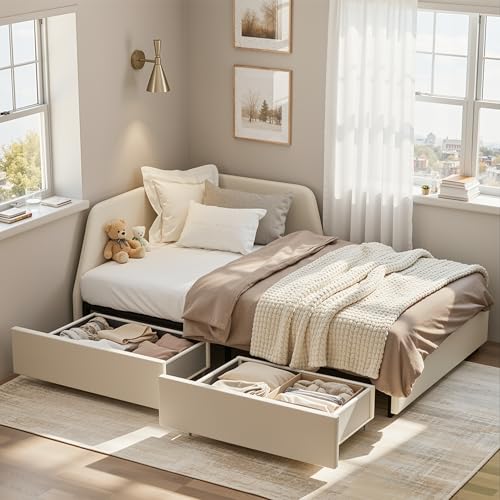
- 【Elegant Minimalist Aesthetics】Arched headboard with ergonomic gentle slope (perfect for reading/leaning) + right-side safety rail for extra support, clean lines elevate high-end
- 【2-in-1 Convertible Design】Effortlessly transforms between twin bed and stylish sofa (no tools needed) – ideal for small spaces, guest rooms, studio apartments
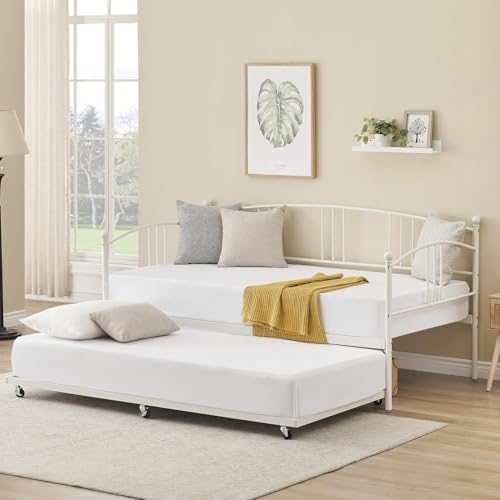
- 【Daybed with Trundle】This versatile metal daybed combines a comfortable sofa and an extra sleeping space, making it a smart choice for small apartments, rental rooms, guest rooms
- 【Durable and Stable】 Built with a sturdy metal frame and reinforced steel slats, this daybed provides reliable support and long-lasting durability. The powder-coated surface helps
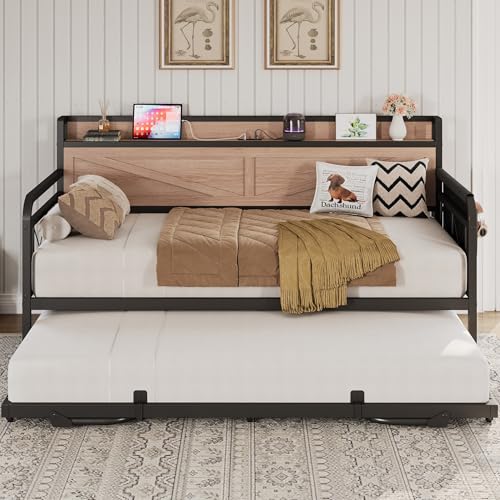
- Excellent Versatility: The twin daybed can be effortlessly transformed from two single beds to a spacious king-size bed, whether it is for daytime use or overnight stays, this
- Storage and Charging 2-in-1: The daybed features a headboard with storage and a charging station, along with extra storage pockets, solving both storage and charging challenges
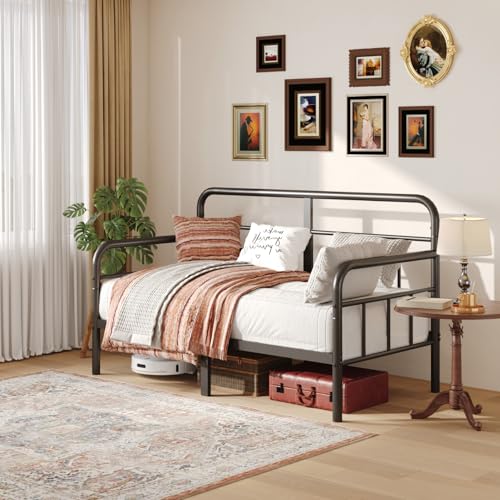
- Sturdy Daybed:Crafted with a high-grade steel frame, reinforced slats, and 6 sturdy support legs, this daybed boasts an impressive 600LBS weight capacity,ensuring long-lasting
- Easy Assembly Daybed Frame&Noise-Free:This twin daybed features labeled components and step-by-step instructions for setup in 30 minutes. Each support leg is equipped with
How to choose
Decide whether you need one sleeper or two. This is the fork in the road. A trundle doubles your capacity without adding footprint, but it also constrains your mattress thickness — the IDEALHOUSE caps at 6–8 inches so the trundle clears the frame. If a single adult sleeps there most nights, skip the trundle and put the money into a thicker mattress and a sturdier frame.
Check the weight capacity against who's actually sleeping there. The spread here runs from 350 lbs to 900 lbs, and that's not a spec you should hand-wave. Nightly adult use, or a daybed that doubles as living-room seating for three people, wants the high end. Occasional kid sleepovers don't.
Look at how the mattress is held in place. Daybeds get sat on from the front, which pushes the mattress forward over time. Retainer bars — which the COMASACH and Yumenonaka both specify — solve this. A frame without them will need a mattress you shove back into place every few weeks.
Measure vertical, not just horizontal. The MSmask has a tall bookcase attached; it's brilliant in a room with normal ceilings and awkward under a sloped attic wall. And if you're anchoring it, plan for a stud.
Think about how it looks nine-tenths of the time. A daybed is a sofa most of the year and a bed a handful of nights. Upholstery reads as living-room furniture; black metal reads as bed frame. Pick the one that suits the room's daytime job.
Read the current reviews before you buy. Assembly experience, packaging condition and finish quality vary batch to batch on furniture at these prices, and the review page is the fastest read on the current state of things.
FAQ
Are queen size daybeds a thing? They exist, but they're rare and defeat the purpose in a small room — a queen daybed is roughly 60 inches deep, which is a very deep sofa. Every option in this roundup is twin size. If you want a queen-width sleeping surface without the daytime bulk, the LIKIMIO Twin Daybed with Pop Up Trundle & Charging Station & Storage Shelf is the closer answer: it pops up to a king-size surface and collapses back to a twin footprint.
Can an adult sleep on a daybed every night? Yes, provided the frame and mattress are up to it. Look for a published weight capacity that suits you, slat spacing tight enough to support the mattress evenly, and no box spring requirement. The frames here range from 350 lbs to 900 lbs, and the higher-rated ones are the sensible choice for nightly use.
Do daybeds need a box spring? None of these do. The LIKIMIO corner daybed uses solid wood slats over metal support; the IDEALHOUSE, COMASACH and Yumenonaka all use steel slat systems that support the mattress directly. Skipping the box spring also keeps the sitting height low enough to feel like a sofa.
What size mattress do I need? A standard twin for all six. Watch the thickness limits: the IDEALHOUSE specifies 6–8 inches for both the daybed and its trundle. On non-trundle frames you have more latitude, but remember that a very thick mattress raises the seat height and can bury a low headboard.
Related guides
- Best Options for Best beds and bedroom furniture - bed frames, platform beds, headboards, bunk beds, kids beds, daybeds, nightstands, dressers, chest of drawers, wardrobes
- Best beds and bedroom furniture - bed frames, platform beds, headboards, bunk beds, kids beds, daybeds, nightstands, dressers, chest of drawers, wardrobes for Small Business Owners
- How to Lower Your Best beds and bedroom furniture - bed frames, platform beds, headboards, bunk beds, kids beds, daybeds, nightstands, dressers, chest of drawers, wardrobes Costs
Key Takeaways
- Choosing the right best daybeds small spaces means matching the key features to your specific needs and budget
- Read real customer reviews and check the return policy before you commit
- Compare value across models — the priciest option is not always the best fit